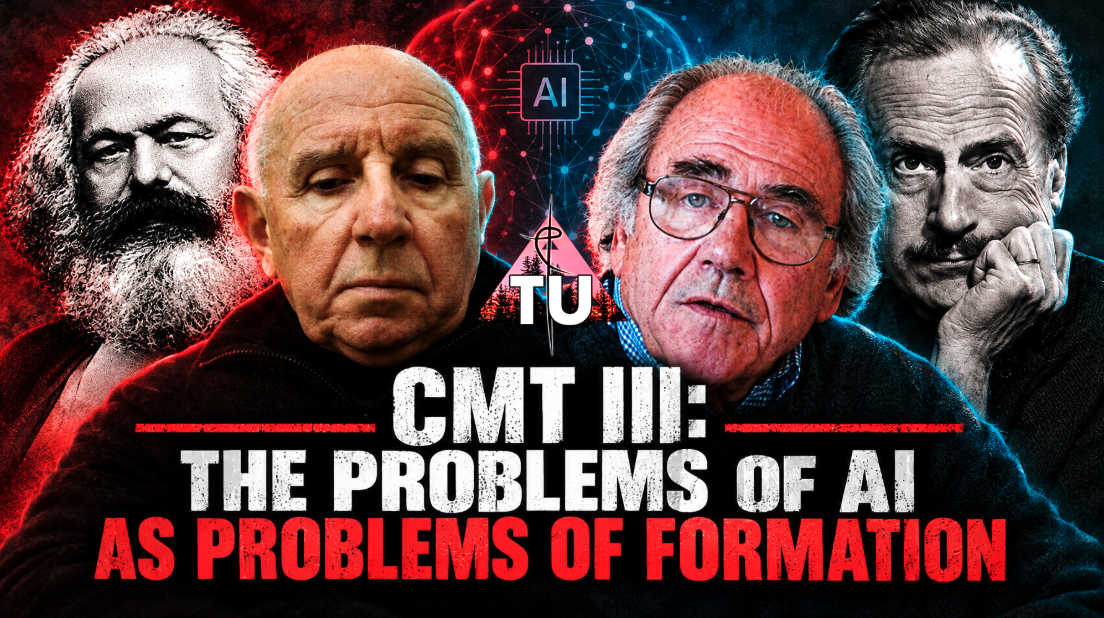
Theory Underground · Critical Media Theory III
Watch the Oct 24 lecture free
20 lectures 8 Saturdays Oct 24 to Dec 19
9 AM Pacific, live on Zoom Every session recorded
Theory Underground / Critical Media Theory III
| Date | Who is up | Pacific | Eastern |
|---|---|---|---|
| Sat Oct 24 | McKerracher | 9:00 to 11:00 AM | 12:00 to 2:00 PM |
| Sat Oct 31 | McKerracher Hansen Bower | 9:00 AM to 1:35 PM | 12:00 to 4:35 PM |
| Sat Nov 7 | McKerracher Bower | 9:00 AM to 12:30 PM | 12:00 to 3:30 PM |
| Sat Nov 14 | McKerracher Hansen | 9:00 AM to 12:30 PM | 12:00 to 3:30 PM |
| Sat Nov 21 | McKerracher Hansen | 9:00 AM to 12:30 PM | 12:00 to 3:30 PM |
| Sat Nov 28 | Thanksgiving weekend, no session | Binge | Hard |
| Sat Dec 5 | McKerracher Hansen 1/2 | 9:00 AM to 12:30 PM | 12:00 to 3:30 PM |
| Sat Dec 12 | McKerracher Bower Hansen | 9:00 AM to 1:35 PM | 12:00 to 4:35 PM |
| Sat Dec 19 | McKerracher Bower Hansen | 9:00 AM to 1:35 PM | 12:00 to 4:35 PM |
McKerracher opens on the 24th. Dec 5 is a McKerracher full lecture plus a Hansen half.
Every session is recorded. Course and V.I.P. tiers keep all twenty videos.
Before you worry about timing
The Oct 24 lecture is free and public, the course proper starts Oct 31, and every session is collected on the site as it happens. The course has a start date. You don't.
Most of the people this is built for are on a shift, or driving, or out in the rows at nine in the morning on a Saturday. The lecture waits for you instead of the other way around.
Every lecture is built from basics and then goes as deep as it goes. Walk in at lecture eleven and lecture eleven will carry you. Running behind and catching up is not the failure state. It is the design.
Who is teaching
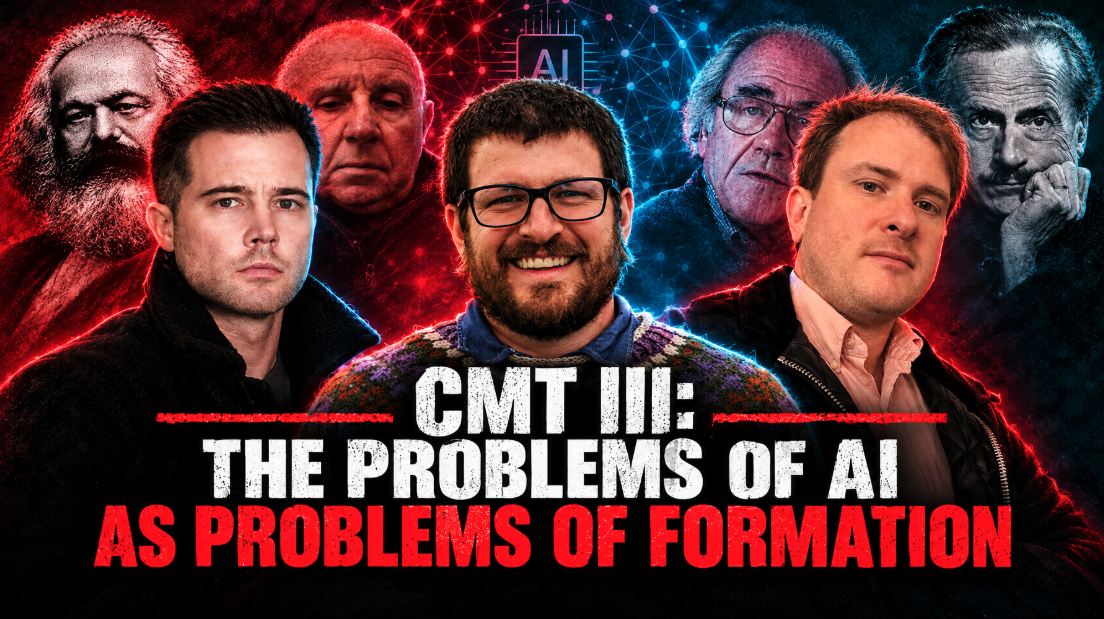
Founder, Theory Underground
Continental philosophy background, which is why he can talk about society without losing the plot, plus analytic training in undergrad, which is why he sometimes succeeds at making himself understood. Author of Waypoint and Timenergy (foreword by Slavoj Žižek), and co-author with Tony Chamas of Post-Left Theory.
Virilio
Author of Tractatus Anti-Academicus, the most scathing critique of the actually existing university system ever penned. Virtualization studies, technoculture, hypermodernity. Based in New York City. His superpower is a kind of intensity and entrancing wonder that supercharges the subject matter.
Baudrillard
A master coordinator, the founder of an ironic cult, and arguably one of the three most Baudrillard-informed people on this planet. Works in the Finnish adult education system, and is especially gifted at unpacking concepts for children, aunts and uncles, and post-grads all at the same time.
| # | Thumbnail | Lecture | Lecturer | Actions |
|---|---|---|---|---|
| 1 |

|
Free Intro to Virilio | Joshua Hansen | |
| 2 |
|
Free Intro to Baudrillard | Christopher Bower | |
| 3 |
|
Free Intro To Marx | David McKerracher | |
| 4 |
|
Free Intro to Heidegger | David McKerracher | |
| 5 |
|
Free Toward a New Theory of Subjectivity? | David McKerracher |
If you want the long version
Open these if you want the argument. Skip them if you already know the vibe.
In academia, "CMT" can, and often does, feel like "CRT." It basically turns into analyzing media products for their inherent prejudices or the ways that they reify, naturalize, or normalize certain structural and historical injustices. In short, it's middle school progressive identity politics with some bigger words. Though this can be interesting, it is not what we are doing.
Peak German philosophy had a much higher standard for "critique" than anything people tend to mean by the term today. We're not talking about nitpicking or playing devil's advocate, but rather, getting to the essential tensions within something by turning it inside out. Critique, in this much more robust sense, does not simply ask what something is, but rather, how it is at odds with itself. This is the approach that doesn't ask what the field of biology studies, but instead studies the generative arguments that constitute it as a field in the first place.
What we're getting at is immanent critique: what Marx brought to political economy by putting Adam Smith and David Ricardo into productive tension with Hegel and Fichte as well as Rousseau and Proudhon, and what Heidegger later brought to phenomenology, hermeneutics, and philosophical anthropology.
Critique in the more rigorous, robust, and based sense is arguably not something you're going to find in academia today. That's why it's on us, third generation philosophy and theory enthusiasts, autodidacts, and post institutional capture researchers, to reclaim the word.
"Media theory" in the proper sense is "medium theory," something that issues from the work of Marshall McLuhan. One could say that Lewis Mumford is the father of medium theory, but really, it's McLuhan, and Mumford is a cousin or grandfather.
Known for his famous saying "the medium is the message," what the idea gets at is that philosophy of technology should not stop by asking about the history, kinds, or nature of machines. As the beings for whom mediation is essential to our formation, perception, and involvements with the world, the real question becomes not simply what affordances are granted by our mechanical environments, but moreover, how are we and the world itself changed through different forms of mediation?
A revolution in the medium is a revolution in the modes possible for human comportment. A play on McLuhan's famous phrase substitutes the word "message" with "massage." He's getting at the idea that the medium functionally massages your central nervous system, which is extended through the medium of reading and writing, the medium of the telephone, radio, television, but also older technologies, like the light bulb, or your literal skin. Subtract any of these forms of mediation from the human and reality will be, in Heideggerian terms, disclosed in very different ways.
Whereas we might have said that we are like fish swimming in the water of the medium, these days it has become much more obvious that we are like the proverbial frogs whose water is heating up slowly. However, unlike the frog who dies because it acclimates to the heating up water, never noticing before it is too late that it reaches a boiling point, we're now noticing.
The rate of change has gotten to be so fast that increasing numbers of people are realizing things are different. The human condition has become a kitchen table topic of interest, because we cannot seem to get off of our phones. Why is it that things have never seemed to change faster, yet we are more immobilized than ever before? It's almost as though the end-game for all of this is that everything becomes everywhere all at once, but we never again, ourselves, actually move.
This is where Paul Virilio, the theorist of speed and the virtual, and Jean Baudrillard, the theorist of simulacra and simulation, both become indispensable for thinking through what it means to live in the cybernetic era. The productive tensions between them will, I wager, bring us into what Heidegger called "a freer relation" with technology.
AI, or the rise of generative LLMs, is the moment when everyone realizes we're arguably living in the future, and it could be lethal. AI describes the convergence point of The Medium, when mediation becomes automatic and potentially self-propagating. It is also a form of cybernetic centralization of an apparatus that had been assumed to be anarchic and distributed. Critique of The Medium is not about rejecting it or deciding whether it is good or bad. It's about understanding its affordances and accidents, so that we can better experiment with harnessing, countering, and pre-empting certain tendencies inherent to its movement and momentum.
No. I never assume you have read the book, sat through the earlier iterations, or heard the earlier lecture, partly because you probably have not, and partly because most of the people who need this work were never handed the chance to.
As my ability to talk about all of this has matured, and the ideas have crystallized, it will actually be easier and more exciting now than ever to take a deep dive into these subjects.
There is no deadline on getting in. The door does not close. What is actually limited is the VIP table, because the whole point of VIP is that there are few enough of us in the room to actually talk. What actually saves you money is going annual on the membership before you buy. So there is a reason to move now, and it has nothing to do with being late.
Reclaim yourself, reclaim the
future
The word "welcome" on our doormat is meant in total sincerity and a spirit of camaraderie. Hope to see you in class.
